PANÛPÜNÜWÜGAI
CARA ROMERO
October 1, 2026 – March 21, 2027
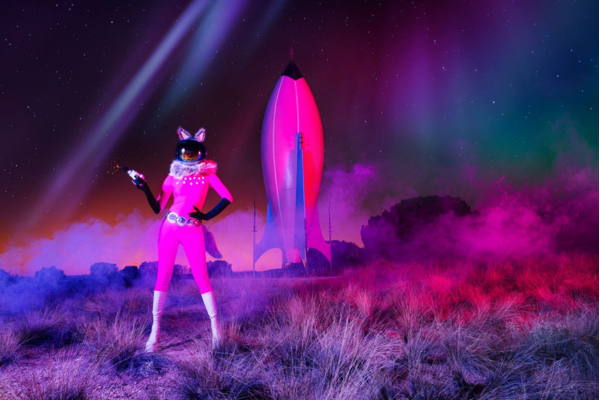
© Cara Romero Coyote Girl, 2024 Archival pigment print Courtesy of the artist
Cara Romero: Panûpünüwügai (Living Light) explores the narrative artistic practice of Chemehuevi photographer Cara Romero. Spanning the past decade of her work, this exhibition presents a thematic examination of Romero’s complex and layered images, which celebrate the multiplicity, beauty, and resilience of Native American and Indigenous experiences.
Romero is a renowned photographer whose visual storytelling challenges dominant narratives of Indigenous decline and erasure. Her work disrupts preconceived notions about what it means to be a Native American and shows the diversity within Indigenous nations and communities. In a photographic practice that blends documentary and commercial aesthetics, Romero creates stories that draw from intertribal knowledge to expose the fissures and fusions of Indigenous and non-Indigenous cultural memory, collective history, and futurity.
“I think it’s important for viewers to understand that my figurative women are not meant to be just human. They are meant to be of elevated, supernatural stature. The spirit of ancestors we possess.”
—Cara Romero
The title of the exhibition, Panûpünüwügai, means “living light” in the Chemehuevi language and refers to the spirit of light. It speaks to the way light interacts with the subjects in Romero’s photographs and to the nature of photography as a “painting with light.”
Cara Romero: Panûpünüwügai (Living Light) is organized by the Hood Museum of Art, Dartmouth College, and curated by Jami Powell, PhD, Associate Director of Curatorial Affairs and Curator of Indigenous Art at the Hood Museum of Art. It is generously supported by leadership gifts from Claire Foerster and Daniel S. Bernstein, Thomas A. and Georgina T. Russo, and support from the Terra Foundation for American Art, the Charles Gilman Family Endowment, and a gift from Karen Miller Nearburg and Charles Nearburg.

Curated for MOCA Jacksonville by Senior Curator Ylva Rouse. Support for MOCA Jacksonville is provided by Exhibition Underwriter Developing Artists Foundation, with additional support from the City of Jacksonville, the Donald and Maria Cox Fund, the Cultural Council of Greater Jacksonville, Joan and Preston Haskell, the MOCA Jacksonville Board of Trustees, MOCA Director’s Circle Members, and the University of North Florida.
Celebrate the Opening
Enjoy an evening of art and community and be among the first to experience Cara Romero: Panûpünüwügai (Living Light) on Oct 1 at 8 p.m. This event is free and open to all. MOCA Members are invited to an exclusive early access preview of the exhibition. Not a member? Join today!
Member-Exclusive Dance Performance
Juya Nokakamea (The Talking Tree)
Oct 1 at 7:30 p.m.
In collaboration with the Dance Department at Douglas Anderson School of the Arts and in dialogue with Cara Romero’s work, a dance performance will be presented during the Member hour of the Opening Celebration. Nationally renowned choreographer Sam Aros-Mitchell is conducting workshops with the students leading up to the performance of Juya Nokakamea. Aros-Mitchell often works at the intersection of performance, memory, culture, and presence.
Extend Your Evening
MOCA Jacksonville has partnered with local restaurants to provide dining options for event guests. Show your event tickets to your server at participating restaurants to receive 10% off your order before or after attending the Opening Celebration event at MOCA! Learn more >>
ABOUT THE ARTIST
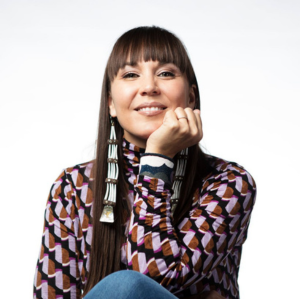 Cara Romero, b. 1977, Inglewood, CA (American / Chemehuevi), is an artist known for dramatic fine art photography that examines Indigenous life in contemporary contexts. An enrolled citizen of the Chemehuevi Indian Tribe, Romero was raised between contrasting settings: the rural Chemehuevi reservation in Mojave Desert, California, and the urban sprawl of Houston, Texas. Informed by her identity, Romero’s visceral approach to representing Indigenous and non-Indigenous cultural memory, collective history, and lived experiences results in a blending of fine art and editorial styles.
Hermosa
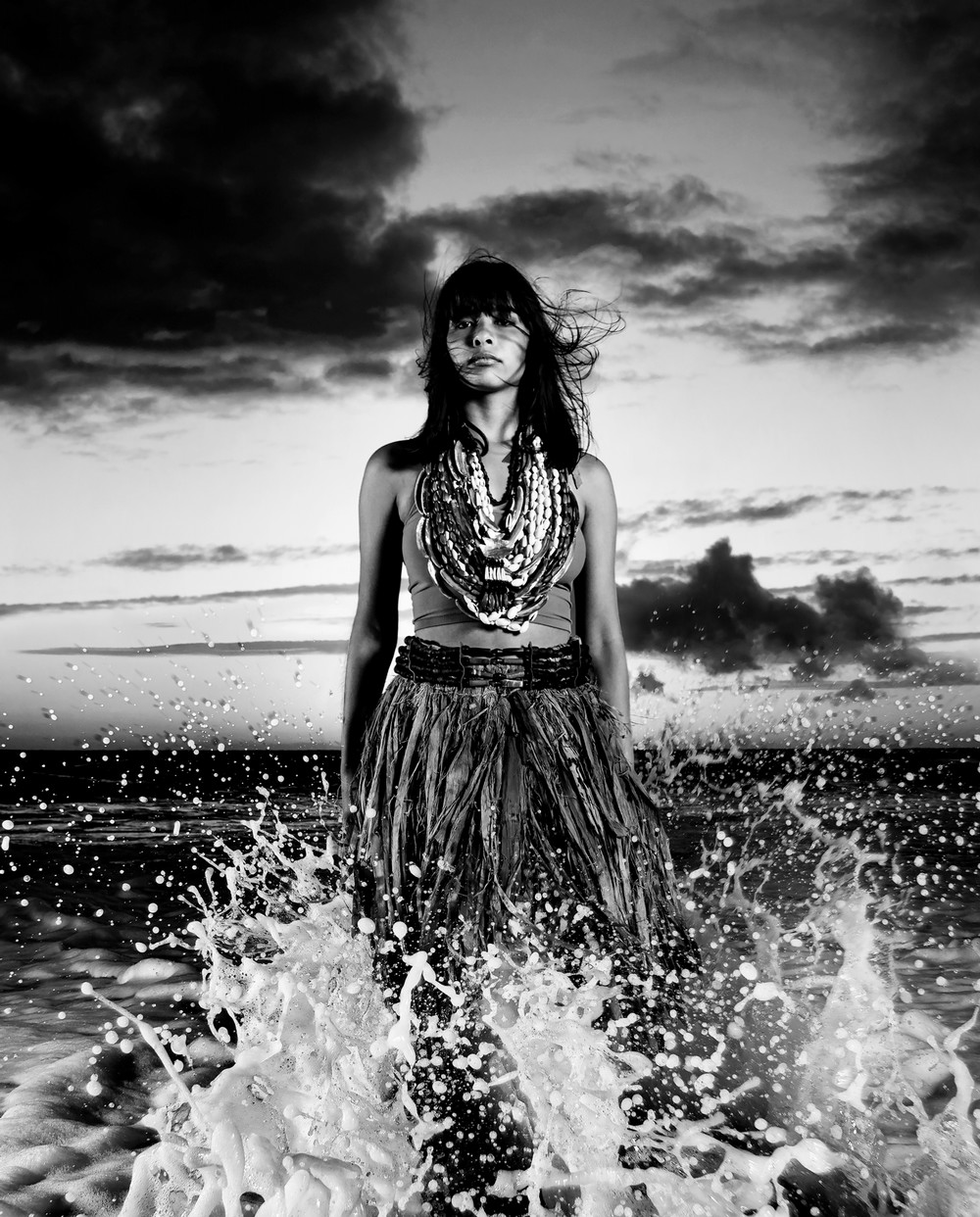 Part of a series of photographs of Romero’s daughter Crickett Tiger (Muscogee Creek and Cochiti) created during the pandemic while their family isolated in southern California, this image was taken at Hermosa Beach at sunset. Unbothered by the surprise wave splashing around her, Crickett embodies the spirit of Hutsipamamow, or Great Ocean Woman—the creator of all life—from Chemehuevi and other California oral histories. In Romero’s own words, “The image pays homage to the original caretakers of this region—first known as Tovaangar. The three months we spent at the beach together in quarantine transformed us and became a communing and healing space of remembrance for me of Chemehuevi creation stories and songs we sing and tell of this place. The photographs that emerged became a visualization of the Indigenous worldview that these places, however developed, are still holy places to First Peoples.”
© Cara Romero Hermosa, 2021 Archival pigment print, Courtesy of the artist
Water Memory
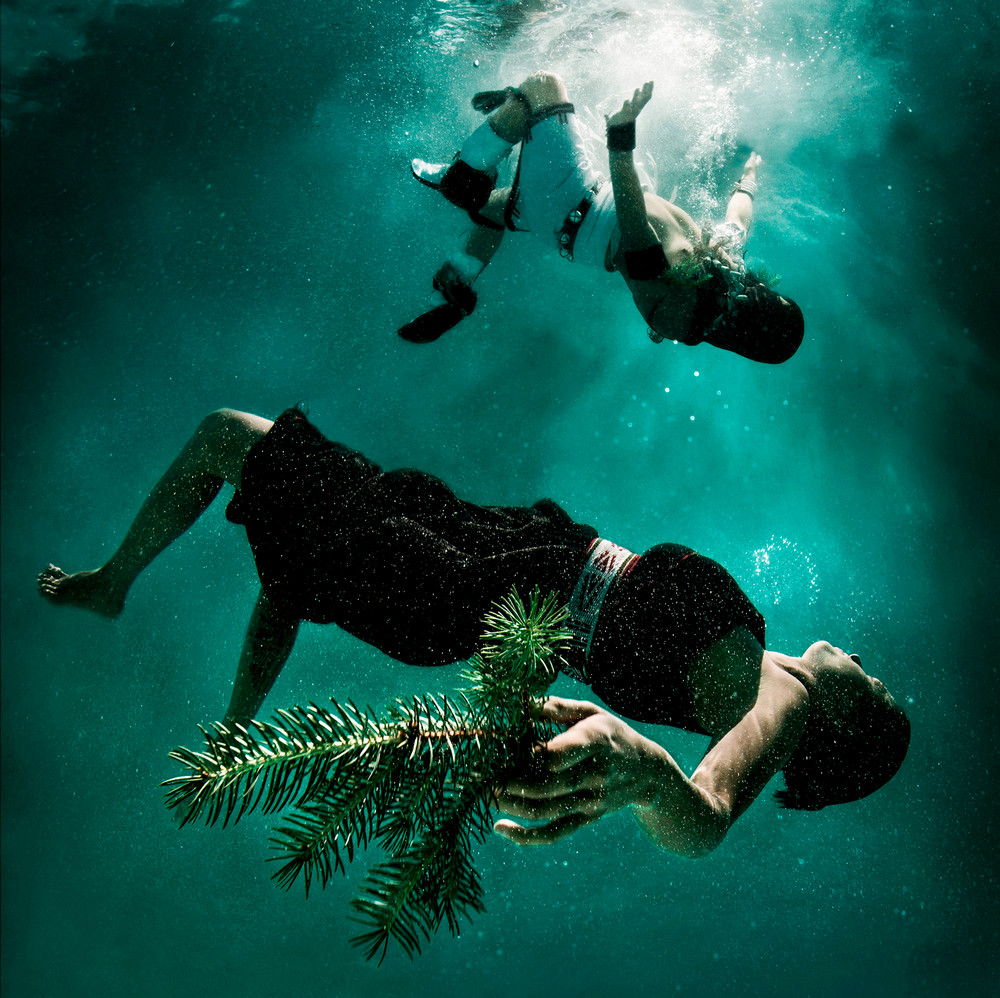 In this image, two figures—male and female Pueblo corn dancers—float, suspended within a drowned landscape. The photograph references ongoing flooding in the aftermath of the 2011 Las Conchas wildfire in northern New Mexico. Although the scene is frightening, the blue green hue of the water simultaneously imparts a sense of tranquility. Water Memory belongs to a larger series of underwater photographs that explore water’s capacity to hold memory, trauma, and life. Romero states: “ Water Memories are photography dreamscapes dealing with Native American relationships to water, the forces of man and of Mother Nature. They are individual explorations of space, memory, and diverse Indigenous narratives that are both terrifying and peaceful.”
© Cara Romero Water Memory, 2015 Archival pigment print, Courtesy of the artist
The Zenith
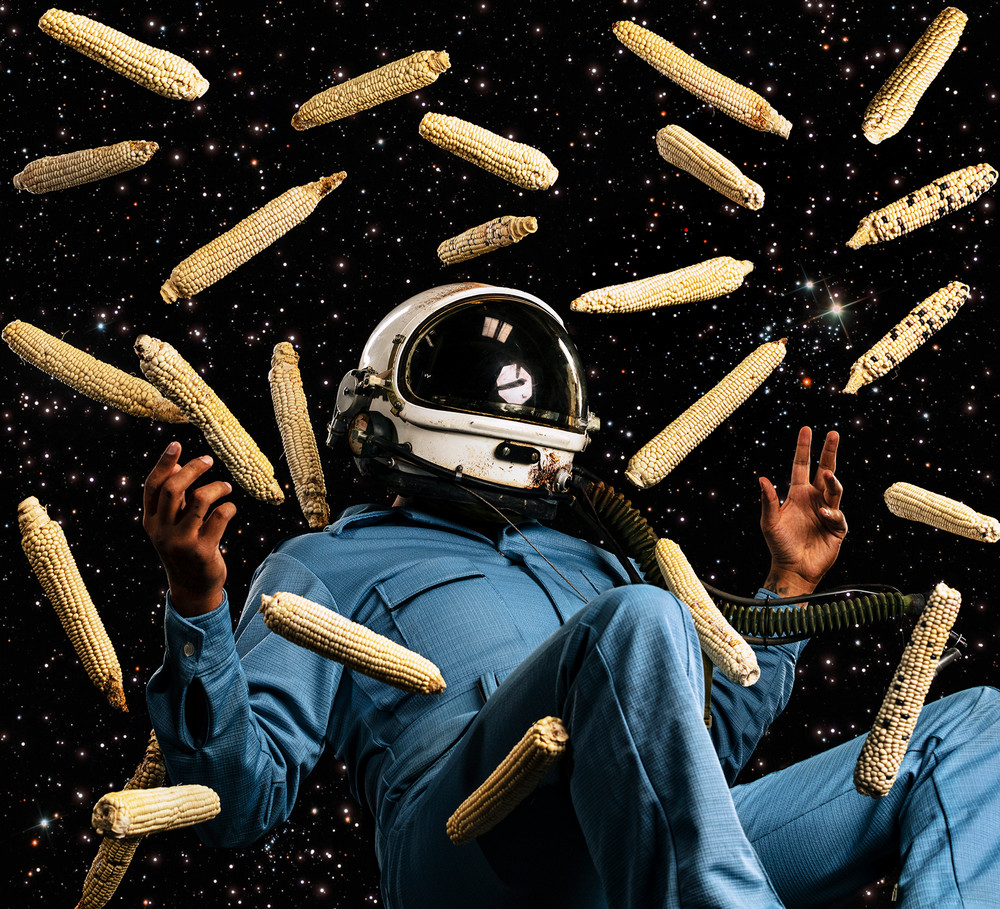 A reference to the astronomical term for the point in the sky or celestial sphere directly above an observer, the zenith is an imaginary space—a space of possibility. Romero worked with Muscogee Creek painter George Alexander to create this lighthearted and magical image depicting him as a weightless spaceman surrounded by dozens of corn cobs. She states: “We have cousins that grow corn out at Cotati. I asked them if I could borrow some of their corn, and they said yes. So, we went out and got a truckload of corn, and then we spent hours tying up corn with fishing line at the studio . . . We left a little space for him to sit in this kind of barber’s chair with a low back. He’s just leaning back in the chair with the corn floating all around him. Then, in post production, I very lovingly took the fishing lines out so that you can’t see them.”
© Cara Romero The Zenith, 2022 Sublimated fabric print, Courtesy of the artist
In Our Own Image: Visualizing Indigenous Florida
Utimile nenebohauela
October 7–November 17, 2026
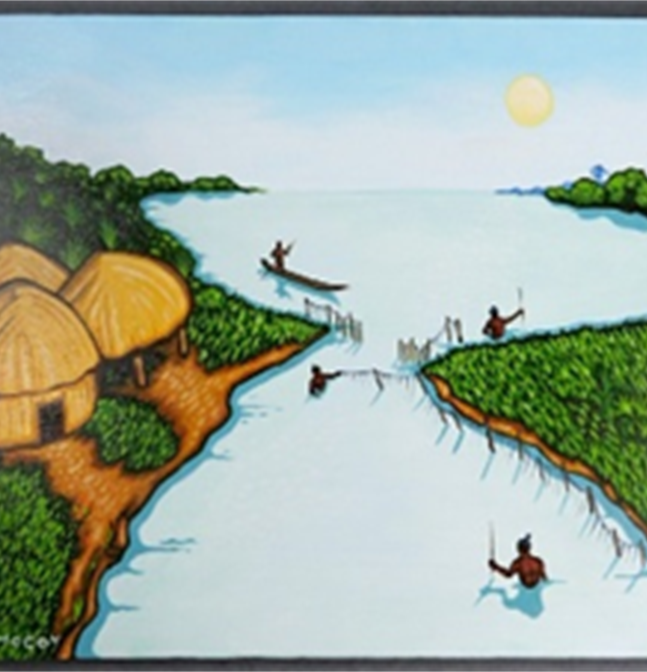
In coordination with MOCA Jacksonville’s featured exhibition of Cara Romero’s work in Panûpünüwügai (Living Light), the museum is pleased to present the accompanying exhibition In Our Own Image, in collaboration with UNF professors Dr. Denise I. Bossy and Dr. Keith Ashley. The exhibition will present the work of seven contemporary Indigenous artists whose works reflect many years of collaborative research into Mocama (Timucua) language, history, and archaeology. More importantly, the works embody the deep knowledge held by Seminole, Miccosukee, and Muscogee citizens and nations about their ancestors.
Ideas of Our Time Lecture
Wednesday, November 4, 2026 | 6–7 p.m.
A roundtable featuring UNF professors Dr. Denise I. Bossy and Dr. Keith Ashley, together with curator Carly Treece (Mvskoke Nation) and Florida-based artists Alyssa Osceola (Seminole Tribe) and Cristina Osceola (Miccosukee Tribe), participants in the exhibition In Our Own Image: Visualizing Indigenous Florida (Utimile nenebohauela).
ABOUT THE COLLABORATORS
Sam Aros-Mitchell
Sam Aros-Mitchell is a Yaqui choreographer, cultural producer, scholar, and performer based in Minneapolis. He is a Jerome Hill Artist Fellow (2025–28), a McKnight Dance Fellow (2023), and the founder of SAROS field/works, a platform for Indigenous and BIPOC-led performance. For over eight years, he has also been a core collaborator with Rosy Simas Danse.
Aros-Mitchell is also the founder of the NE/X Festival (Northeast Experimental): A Festival of Indigenous Performance and The Native Joy Play Festival: A Celebration of Indigenous Creativity and Community. He serves on the Native American and Indigenous Studies Association Council and is the founder of Aros & Son LLC, a Native-owned company he co-founded with his son to support Indigenous publishing, collaborative media projects, and mentorship.
Across all projects, Aros-Mitchell’s practice is guided by kinship, ritual, and the belief that performance is not merely art; it is an embodied act of presence, memory, and cultural continuity. He holds a Ph.D. in Drama and Theater from the joint doctoral program at UC San Diego and UC Irvine, an MFA in Dance Theater from UC San Diego, and a BFA from UC Santa Barbara.
He is among the first Yaqui artists to reconstruct and perform José Limón’s The Unsung (Deer Solo) and Danzas Mexicanas (Indio Solo), infusing these historic modernist works with Indigenous embodiment and critical recontextualization. Recent original works include Juya Nokakamea (2024), a multi-sensory performance drawn from Yaqui creation stories, and Entering Aniam (2023), an immersive sound and movement installation.
Learn more about Sam Aros-Mitchell >>
Dr. Keith Ashley
Keith Ashley (Ph.D., University of Florida, 2003) is an archaeologist and associate professor of anthropology at the University of North Florida. His current research focuses on the Indigenous peoples and histories of southeastern North America, particularly Florida. Presently, he is exploring the involvement of St. Johns River fisher-hunter-gatherers in the broader world of Indigenous farmers during the 10th through the 13th centuries CE.
His research also delves into the 16th- and 17th-century social landscape of the Indigenous Timucua-speaking Mocama. He is actively involved in archaeological excavations with UNF students throughout northeastern Florida.
Learn more about Dr. Keith Ashley >>
Dr. Denise I. Bossy
Dr. Denise I. Bossy is a professor of history at the University of North Florida and North American editor-in-chief of the journal Ethnohistory. She received her BA from Princeton University and her Ph.D. from Yale University. Her teaching and research focus on Florida, local Indigenous history, public and digital humanities, and the Native South.
Her award-winning publications include The Yamasee Indians: From Florida to South Carolina (University of Nebraska Press, 2018). Her forthcoming book, Yamasee: Indigenous Mobility and Power in the Early South, is under contract with the Omohundro Institute at the University of North Carolina Press.
She is currently working with Dr. Keith Ashley on a public-facing book and digital humanities site that examines the deep history of the Mocamas, Guales, and Yamasees of Northeast Florida. This work is funded by a three-year National Endowment for the Humanities Collaborative Research grant.
ADDITIONAL RESOURCES
Northeast Florida:
Timucuan Ecological & Historic Preserve: History & Culture
Boardwalk Talk: “Local Indigenous Nations” with Dr. Bossy
Did an Indigenous Metropolis Once Stand in What’s Now Downtown Jacksonville?
Other Presentations
National and Local Presentations by Dr. Denise I. Bossy and Dr. Keith H. Ashley
General Indigenous Florida
Native American Heritage Month: Indigenous Florida