
TARA DONOVAN
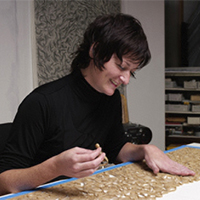 New York-based artist Tara Donovan is a sculptor of everyday materials. After spilling a box of toothpicks on her studio floor and noticing the perfectly formed cube, Donovan went on to explore the aesthetic possibilities of ordinary mass-produced objects-metal pins, plastic cups, pencils, buttons-in her sculptures. Though Donovan was originally drawn to the accessibility and affordability of such goods, her exploration of a material's unique physical properties is the motivating force behind her sculptural compositions. For example, the artist's interest in translucency is visible in the use of adhesive tape or plastic drinking straws.
Creating Donovan's installations is no small feat. Frequently, the artist and her assistants partake in the days-long, laborious process of amassing tens of thousands of singular units into one larger-than-life sculpture. Such was the case for MOCA Jacksonville's preparation of the monumental wall installation Haze, in which Donovan reconceives the universally understood use of a plastic drinking straw. By turning the object on its side and stacking it perpendicularly to the wall, the hollow form creates an atmospheric wave-like surface, or “white haze.” The use of the straw not only highlights the artist's attraction to the reflectivity of transparent substances but is one example of how she repurposes and transforms simple manufactured materials into extraordinary works of art. It is only upon close inspection that one recognizes the site-specific installation, or “site-responsive” as the artist prefers to call it, as the result of the accumulation of straws.
While many of Donovan's sculptures refer to man-made objects, some sculptures mimic nature. In fact, her crystal collection inspired the natural form found in Untitled. Donovan invents a process of assembling and gluing acrylic plastic rods to a steel armature to create a larger-than-life astonishing crystal that appears to be lightweight but is surprisingly heavy.
Haze and Untitled present the color white as an apparition, one that becomes increasingly more palpable through the additive process of collecting identical objects. The artist once described the importance of color: “Color is often what I like to refer to as a 'figurative' quality in my work. It is a trait that often only becomes evident with accumulation.” The conjuring of whiteness in her work, then, is primarily the result of accrual, hastened by the serial repetition of geometric forms and rule-based system of assembly she employs.