THE AMERICAN CENTURY
Works from the Museum of Contemporary Art Jacksonville Collection
July 18, 2026 - March 7, 2027
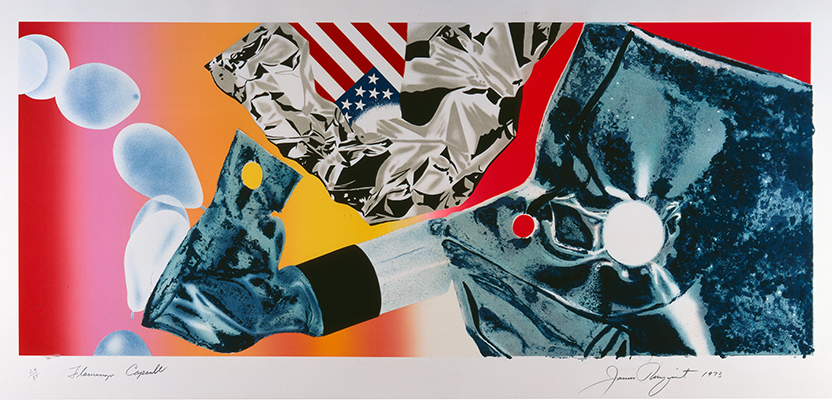
James Rosenquist, 'Flamingo Capsule', 1973, Color lithograph with screenprint. Museum Purchase Fund and South Central Arts Committee, Prudential Insurance Company.
The American Century marks the 250th anniversary of the United States by celebrating and exploring the emergence of a distinct American art that redefined the aesthetic landscape of our era.
The seismic transition of the United States from isolationism in the early twentieth century, to its role as a global leader of democratic ideals post-World War II, brought publisher Henry Luce to famously declare the 20th century as “The American Century.” While crucial economic and political shifts were evolving globally, this change was especially evident in the world of art, when in the late 1940s the center of gravity crossed the Atlantic, shifting from the salons in Paris to the studios in New York City. The American Century charts the birth of a uniquely American vocabulary that, marked by continual innovation and change, would transform the way we understand the arts in our time and place. Through works in MOCA Jacksonville’s permanent collection, the exhibition spans from the transformative raw energy of Abstract Expressionism and its succeeding ramifications, through to the kaleidoscopic perspectives of today’s artists, capturing the richness of our ever-unfolding contemporary narrative
Abstract Expressionism
Emerging in the 1940s, Abstract Expressionism became the first specifically American art movement to achieve international influence. The participating loose collective of artists—including Jackson Pollock, Willem de Kooning, Franz Kline, Lee Krasner, Norman Louis, and Mark Rothko—came to be known interchangeably as Abstract Expressionists, the New York School, or Action Painters.
Drawing from postwar existentialism and Surrealist automatism, these painters rejected the representation of the external world. Instead, they championed pure self-expression, transposing what artist Robert Motherwell called “felt experience” directly onto the canvas. This gave the artists an unprecedented freedom of execution. When painting is liberated from the task of representation, the expressive powers of line, color, and form can be explored. As critic Harold Rosenberg famously observed in 1952, the canvas was no longer a space to reproduce an object, but “an area in which to act.” For the Action Painters, the final artwork was the physical trace of an event.
A subsequent generation of artists, known as the “Second Generation”— including Ed Clark, Sam Francis, Helen Frankenthaler, Michael Goldberg, Al Held, and Joan Mitchell—expanded the movement’s tenets in diverse stylistic directions, leaning variously into the color-field aspects, the gestural characteristics, and the literal or figurative aspects. These developments would allow Color Field painting, Hard-edge abstraction, and Lyrical Abstraction to emerge, but also the happenings, performance art, Minimalism, and Conceptual Art that would follow.
Special thanks to Ted and Lauren Baker and Joan and Preston Haskell for their generous support and participation.